Interview with Benedikt Kern from the Ökumenisches Netzwerk Asyl in der Kirche in Nordrhein-Westfalen

This interview was conducted by Azher Hameed Qamar, a post-doctoral researcher in the COFUND project Migration, Diaspora, Citizenship, with Benedikt Kern, a theologian who works at the Ökumenisches Netzwerk Asyl in der Kirche in Nordrhein-Westfalen.

As part of my ongoing work on migration, diaspora, and citizenship, I spoke with Benedikt, a staff member at the Ökumenisches Netzwerk Asyl in der Kirche in Nordrhein-Westfalen. His organization supports parishes across Nordheim-Westphalia in offering church asylum, providing theological, legal, and practical guidance to communities that protect people at risk of deportation. In this conversation, Benedikt reflects on the grassroots structure of the church asylum network, the moral and political tensions surrounding migration in Germany, and the role of faith-based actors in responding to border violence and restrictive asylum regimes. His insights offer a grounded perspective on solidarity, human rights, and the everyday realities of protecting vulnerable migrants.

Q: Can you explain your role and the work done by your organization regarding church asylum?

A: I work at the Institut für Theologie und Politik (Münster) on the topic of church asylum (Kirchenasyl), supporting parishes in the Nordrhein-Westphalia region with all questions related to church asylum. This includes theological, juridical, and practical support from Catholic, Protestant, and evangelical churches. Over the past year, we organized between 500 and 600 church asylums in Nordrhein-Westphalia.

Q: Is there a network structure leading this work, or how is it organized?

A: It’s a grassroots network with no hierarchical leadership structure. The association, founded in 1994, is called Ökumenisches Netzwerk Asyl in der Kirche in Nordrhein-Westphalen. It’s financed through donations, church subsidies, and foundations. We have offices in Münster and Köln, with a team of five to six people supporting church asylum in Nordrhein-Westphalia.

Q: How is migration, particularly refugee migration, perceived in German society, and what are the main perspectives on this issue?

A: German society (post-WWII) has always had issues with racism, and migration has long been seen as a problem, often associated with criminalization and border control.

There are three main perspectives, especially regarding refugee migration:

  • Right-wing perspective: Sees refugee migration as illegal and opposes welcoming refugees.
  • Neoliberal perspective: Supports migration for economic reasons, both for low-skilled and highly educated workers (Fachkräftezuwanderung). Recent governments have changed laws to facilitate work migration but have also tightened asylum procedures.
  • Solidarity perspective: Emphasizes human rights and the necessity to welcome those fleeing danger. Church asylum aligns with this view, prioritizing the protection of everyone’s right to freedom of movement, regardless of nationality or status.

Q: Earlier in our conversation, you mentioned Pope Leo describing border violence as a “crime.” What does that mean?

A: Yes. He referred to the violence and police brutality at borders as governmental crimes. When states refuse to accept asylum seekers and use violence or pushbacks, it constitutes a crime against humanity. For example, he said in his speech:

“States have the right and the duty to protect their borders, but this should be balanced by the moral obligation to provide refuge. With the abuse of vulnerable migrants, we are witnessing not the legitimate exercise of national sovereignty, but rather grave crimes committed or tolerated by the state. Ever more inhumane measures are being adopted — even celebrated politically — that treat these “undesirables” as if they were garbage and not human beings. Christianity, on the other hand, refers to the God who is love, who creates us and calls us to live as brothers and sisters.”

Q: Many migrants coming to Germany are from different cultural and religious backgrounds, particularly Muslim-majority countries. How does your organization or churches accommodate these differences?

A: Within churches, there are varying views, but most parishes we work with focus on protecting people from deportation, regardless of their religion. The essential requirement for a good church asylum is maintaining strong, trusting relationships within the parish—both among the guests and the people who are actively engaged in supporting them. Most church asylums in Germany welcome Muslim or atheist refugees, not just Christians. For us, the central value is solidarity and living together, not forcing assimilation into German society. Our priority is protecting people from border violence and deportation regimes, which we see as problematic for German society.

Q: Can you clarify the difference between “church” and “parish”?

A: “Church” refers to the institutional structure—like the Catholic diocese or Protestant church administration hierarchy, including bishops, clergy, and administrators. These institutions often have a critical view of church asylum, prioritizing their relationship with the state. “Parish” refers to the local community level, where decisions about church asylum are made. Local parishes are more likely to support church asylum based on values like mercy, freedom, and justice.

Q: From a Christian perspective, how do you see the church’s asylum and the validity of law?

A: From a Christian perspective, the validity of a law cannot be absolute, but must always be measured against the criterion of whether or not it helps the weakest. Jesus puts it this way: Is man there for the Sabbath law, or is the Sabbath law there for man? This understanding of the law also guides action in church asylum: even if church asylum conflicts with state law, it is legitimate, even if it is not legal.  

Q: How does the church network interact with bureaucracy, politics, and the media regarding church asylum? Can you share examples?

A: Since 2015, there is an agreement between the Catholic and Protestant churches and the German government that church asylum is accepted in certain cases, especially under the Dublin Regulation. During the six-month Dublin procedure, if churches protect someone, they can request a case review with the BAMF (Federal Office for Migration and Refugees). Most of these requests are denied, so churches often wait out the six months, after which deportation is no longer possible, and the person can enter the national asylum process.

Sometimes, there is pressure from authorities on parishes to end church asylum within six months, but parishes must remain strong. Rarely, police have forcibly removed people from church asylum, which we publicize in the media to pressure the government and defend the practice. With the rise of far-right parties, we expect more challenges and will need to increase our advocacy to ensure church asylum is tolerated as a form of human rights protection.

Q: Thank you so much for your time. I appreciated your openness and the depth of your reflections.

A: Thank you.

This interview highlights the complex moral, political, and practical dimensions of church asylum in Germany. Benedikt’s reflections reveal how local parishes navigate state pressure, shifting asylum policies, and rising hostility toward migrants while remaining committed to solidarity and human dignity. His account underscores the importance of grassroots networks, interfaith cooperation, and public advocacy in defending the rights of those facing deportation and border violence. This conversation with Benedikt contributes meaningfully to our understanding of migration and the role of faith-based communities in supporting those seeking protection.

Rethinking Social Resilience: Towards a Lived-Experience Approach in Migration Studies

Azher Hameed Qamar

Postdoc Fellow COFUND Migration, Diaspora, Citizenship

University of Münster

Resilience is now becoming a popular term in migration studies and policy debates. Particularly in the context of migrants’ integration, it is often seen as a desired ability that helps migrants do well even when things are difficult. This dominant rhetoric frequently conceptualizes resilience as an individual characteristic or ability, overlooking the underlying social and political processes, structural conditions, and institutions that significantly influence migrant experiences. Such technocratic and neoliberal framings of resilience shift the burden of responsibility onto individuals, obscuring the complex, relational, and contextual factors that shape migrants’ lived experiences.

This blog post is based on my research on social resilience and migrants’ lived experiences. I propose to explore social resilience as a concept that is based on the lived experiences of migrants, reconceptualizing it as:

A social phenomenon marked by the social experiences and practices of vulnerable individuals or groups as they navigate political, economic, cultural, and social (PECS) changes and challenges (Qamar, 2023a).”

Through these experiences, individuals and groups learn to re‑examine their lives within new contexts and develop adaptive and transformational capacities. From a life-course perspective, this is an ongoing process. During the process, migrants’ status, social networks, accessible resources and support, and visibility illuminate how migrants adapt and change in a world where they bear the responsibility to be integrated. This perspective proposes the concept of resilience as a dynamic, socio-political process that develops via everyday interactions and institutional involvement.

Reconceptualizing Resilience Beyond the “Bouncing Back” Paradigm

By and large, accepted definitions of resilience focus on the capacity or ability to “bounce back” from adversity, which highlights coping strategies and recovery following challenging circumstances. This approach addresses key aspects of adaptation; however, it is inadequate, particularly in the context of migration influenced by persistent crises such as climate change, globalization, and socio-political crises. Researchers now argue for a broader conceptualization of resilience, which includes the idea of “bouncing ahead,” referring to the process-oriented resilience through which migrants adapt, (re)learn, (re)examine, and move forward in society (Qamar, 2023a, 2023c).

The shift in perspective means that it is necessary to recognize the diverse social experiences and behaviors in resilience studies. Migrant populations exemplify the dynamic interplay between agency and structure; as individuals and families transition from precarity to stability, their choices, strategies, and adaptations are inextricably linked to the social, political, and cultural contexts in which they live. In this connection, a life‑course perspective offers a valuable analytical lens for examining how lives, identities, and belonging evolve over time, providing a useful approach for understanding these processes. Focusing on resilience, a life‑course perspective has rarely been applied in migration research, yet it offers significant potential for illuminating the temporal and relational dimensions of migrant resilience.

Social Resilience: A Lived‑Experience Perspective

By the end of the twentieth century, resilience research primarily focused on individual characteristics, suggesting that personality characteristics such as self-esteem, temperament, competence, and cognitive abilities influence the ability to withstand adversity. Critics pointed out that such models as “heroic resilience” are narrow and often downplay the crucial role of institutions, social structures, and social actions (Qamar, 2024a).

On the other hand, the concept of social resilience focuses on the ability to withstand crisis and restructuring. This ability is shaped by access to livelihoods, resources, and institutions, all of which exist within evolving socio-political contexts (Adger, 2000; Adger et al., 2002). With this relatively new conceptualization, ‘social resilience’ emerged as the key concept in contemporary resilience research. However, resilience in the context of migration is fundamentally a social, cultural, and political phenomenon shaped by interdependence, institutional arrangements, collective responses, and the dynamic interactions between actors and their socio‑political contexts (Keck & Sakdapolrak, 2013; Obrist et al., 2010; Qamar, 2023a, 2023c). Hence, resilience is understood as a dynamic social process that shapes the abilities to respond, recover, and move forward within specific contexts (Bohle et al., 2009; Dagdeviren & Donoghue, 2019; Qamar, 2023a).

Recent multidisciplinary research has broadened the understanding of resilience, emphasizing how it applies within social, political, and cultural systems. For example, Ungar’s (2012) socio-ecological approach emphasizes how resilience is culturally situated and influenced by the person-environment interactions, complexity, and cultural relativity. This approach acknowledges a spectrum of resilience strategies, particularly within vulnerable groups such as migrants.

Migration, whether voluntary or coerced, represents a significant transition characterized by fractured family connections, financial constraints, language barriers, and the development of new social roles. These interruptions create a “new normal” state for the migrants in which they struggle to adjust, redefine their belonging, and experience personal and social transformation. In this context, social resilience is an evolving process shaped by cultural practices, interpersonal relationships, community values, and institutional supports. It is deeply ingrained in and driven by the political, economic, and cultural contexts that migrants experience. 

A lived experience perspective in migration studies is particularly useful for examining the developing process of resilience through continuity, decisive moments, and interdependence. It presents resilience as an inherently social phenomenon that is shaped by the continuous interplay between migrants and the political, economic, cultural, and social contexts of the host country. Migrants’ vulnerability, evident in marginalization, racism, restricted access, and political invisibility, significantly influences the process of resilience.

Conclusion

In the field of migration studies, the concept of social resilience needs to be adequately framed to capture a bottom-up understanding of migrants’ lived experiences. It should be examined as a social construct, giving voice to the participants in the research. Rethinking social with a lived experience approach will help to include the interaction of social, cultural, economic, and political factors in understanding resilience. It will also help to emphasize the importance of community practices, institutional interactions, and the broader environmental context. By recognizing lived experiences as valid empirical data, scholars, policymakers, and practitioners can better understand the migrants’ agency and the complexity of inclusion, belonging, and a meaningful existence in their everyday lives.

References

Adger, W. N. (2000). Social and ecological resilience: are they related? Progress in Human Geography, 24(3), 347–364.

Adger, W. N., Kelly, P. M., Winkels, A., Huy, L. Q., & Locke, C. (2002). Migration, remittances, livelihood trajectories, and social resilience. AMBIO: A Journal of the Human Environment, 31(4), 358–366.

Bohle, H. G., Etzold, B., & Keck, M. (2009). Resilience as agency. IHDP Update2(2009), 8–13.

Dagdeviren, H., & Donoghue, M. (2019). Resilience, agency and coping with hardship: evidence from Europe during the Great Recession. Journal of Social Policy48(3), 547–567.

Keck, M., & Sakdapolrak, P. (2013). What is social resilience? Lessons learned and ways forward. Erdkunde67(1), 5–19. https://www.jstor.org/stable/23595352

Obrist, B., Pfeiffer, C., & Henley, R. (2010). Multi-layered social resilience: A new approach in mitigation research. Progress in Development Studies10(4), 283–293.

Qamar, A. H. (2023a). Conceptualizing social resilience in the context of migrants’ lived experiences. Geoforum, 139, 103680.

Qamar, A. H. (2023c). Social dimensions of resilience and climate change: a rapid review of theoretical approaches. Present Environment and Sustainable Development, 17(1), 139-153.

Qamar, A. H. (2024a). Social Resilience: A Critical Synopsis of Existing Definitions. Corvinus Journal of Sociology and Social Policy, 15(1).

Ungar, M. (2012). Researching and theorizing resilience across cultures and contexts. Preventive Medicine: An International Journal Devoted to Practice and Theory, 55(5), 387–389. https://doi.org/10.1016/j.ypmed.2012.07.021

READING THE SOUTH-WESTERN SCRIPT OF IRON AGE IBERIA IN A MASS-MIGRATION CONTEXT: A NEW FRAMEWORK FOR THE DECIPHERING OF THE SCRIPT WITH CASE-STUDIES

Eleftheria Pappa

Senior Fellow, “Migration, Diaspora, Citizenship”

University of Münster

The deciphering of the South-Western script of Atlantic Iberia has seen new recent advances but the consensus, to the extent that it exists, has not facilitated the reading, and even identification, of the recorded language. Suggesting new phonemic values ascribed to the signs, taking into account the inroads that both the Phoenician and Greek scripts made into the Iberian Peninsula (a fact which is archaeologically corroborated), I propose a new reading of the inscriptions that actually both offers satisfying, if partial, readings of the inscriptions, and matches their known context and function. I test the hypothesis presented here using three case-studies: the better-preserved Mealha Nova I and Abóboda inscriptions and the fragmentary Herdade do Pêgo I. This improvement offers new avenues for the reading of the corpus of the South-Western script and the understanding of a Proto-Celtic language spoken in the early 1st millennium BCE and through to the early centuries of Roman annexation.

INTRODUCTION

            The enquiry into notions and attestations of citizenship in Iron Age Atlantic Iberia within a migration context, inevitably zeroes in on one of the most valuable cultural assets of migration during this period: literacy. Even if the concept of citizenship -the idea of belonging to a particular, civic community – was not introduced through the migration of peoples from the Near East, i.e. from regions with comparatively more developed political institutions within urbanized societies that affected local forms of community organization or the share of power among populations already settled in the Peninsula, it is literacy that allows us to delve into the matter.

            Echoing developments at the other end of the Mediterranean, where the Phrygians, Lydians and Greeks developed alphabetic scripts for their respective languages, the Phoenician consonantal script was adapted in Iberia during the period of Phoenician colonization by several groups, independently of one another. As gauged through the epigraphic record, in this period affected by earlier mass migration, several languages and scripts were circulating at the same time in Iberia. This fissiparous, multi-ethnic population, the result of successive migratory waves into the Peninsula, formed a mosaic of populations with distinct ethnic and linguistic identities, some of which survive to the present as distinct linguistic groups (e.g. Basque).

            Brief inscriptions on funerary monuments recorded in the earliest script to be developed in Iberia name the deceased and their links to particular places. This so-called South-Western (SW) or ‘Tartessic’ script is attested in inscriptions on roughly-hewn stone stelae used as grave markers and as graffiti on pottery. About 100 inscriptions on stelae are known, in situ or dispersed within the original sites. Apart from the stone stelae, the SW script is also found as graffiti on pots. They mostly come from southern Portugal (Algarve, Baixo Alentejo), though fewer are known from western Andalusia, and even Extremadura) (Guerra 2010). The script is consistently associated with locations inhabited by indigenous populations in inland area albeit adjacent to major colonial centres or towns immersed in what is presently-termed Orientalizing culture. Doubts about the end point of the use of the SW script derive from the problematic dating of some of the inscribed artefacts and the uncertainty over its relationship to the locally-developed, so-called Paleo-Hispanic script documented in the legends of coins issued by Salacia (Alcácer do Sal) through to the Roman period (Correia 2004), when several cities struck coins displaying toponymic legends in Latin that preserved the Iron Age city names, such as Ossonuba, Baesuris etc (Fig. 1). In some cases, as on the later issues of Salacia, coins bore legends in both Latin and Paleo-Hispanic scripts.

            The Latinization of Hispania Ulterior is seen as a gradual process, spearheaded by the social and financial interests of local elites eager to maintain their status (Estarán Tolosa & Herrera Rando 2024). An oft-occurring omission in these discussions is that this process advanced most rapidly in southern Iberia where the urban populations that quickly adopted the Latin alphabet and language had enjoyed literacy for more than half a millennium by the time that the Roman empire extended its frontiers to Iberia, at the very least in the southern portion of the two new provinces, which also facilitated their inclusion into the empire. Although proscriptions against the use of local scripts never appear to have been legislated by the Roman authorities, the adoption of Latin conferred an advantage, independent of Rome’s desiderata: it provided a linga franca in an Iberia that was inhabited by people that spoke multitudes of different languages and used various scripts. Later attestations in the Latin alphabet corroborates this picture, allowing us to chart the linguistic intricacies that the corresponding Paleo-Hispanic epigraphic record adumbrates. Examining the personal onomasticon and ethnic names of several groups, as they survive in historical and epigraphic sources dating to the Roman period, the identification of a Celtic linguistic substratum among the Lusitani and those that the Romans termed ‘Celtiberians’ – an exonym to differentiate this Celtic group that they encountered from the inhabitants of Gaul – is indisputable (García Alonso 2008). Since the Celtic language was not a Roman-era development, the epagogic conclusion must be that the SW script was used to write a form of language that by Roman times was considered Celtic. Far from being a cynosure in studies of literacy in Europe and in the Mediterranean, the SW script possesses the primacy of being the earliest indigenous writing anywhere in western Europe but also in the western Mediterranean, almost of comparable date to the earliest attestations of the Greek language in an alphabetic script. In addition, the subject is of great interest to many other fields that deal with the Bronze and Iron Ages of western Europe, where the investigation into the diffusion of the Celtic language(s) as the result of seaborne migrations or a westward expansion from central-eastern Europe continues to be debated (e.g. Koch et al. 2025). With the mass migration of populations from Greek and Phoenician cities, these languages acquired scripts that were locally adapted from eastern Mediterranean ones. This is not to resurrect ideas prevalent in Vallancey’s (1772) essay on the Irish language being a “collation of the Irish with the Punic Language”, but instead to explain a script used to record a Celtic language within the multi-ethnic historical context.

            For any inscription to be read, first the script has to be deciphered, then the language identified and finally, the pinnacle of this process ensues with the aid of historical linguistics. The existing consensus on the SW script is that the first step has been almost accomplished. The vexing problem in this regard is that this deciphering method has not allowed for any reading of the inscriptions, despite the fact that the language is most likely an early form of Celtic. Artefacts inscribed with the SW script continue to be found, yet with little advancement in knowledge on the script per se. It has not helped that these ancient inscriptions are published often without the ancient signs as documentation but with their assumed and contested phonemic values, even as there is no consensus on the deciphering of the script.  Moreover, it is almost implicitly assumed that there existed some form of state-like oversight from the beginning, tasked with the systematization of the script and that all variants have to reflect some new sound or orthographic combinations of signs. As early documents of a Celtic language written in an earlier form of script, their reading suffers from an ill-guided consensus on the deciphering of the script, on principles established more than half a century ago, which prevents the actual reading of the script. The fact that these SW inscriptions, pertaining to the locally-developed Paleo-Hispanic scripts have not been read despite several decades of intensive research is, as tentatively propounded here, due to the erroneous reading of the SW script as a semi-syllabic one, rather than alphabetic, owing to the fact that their study has for several decades adhered to the initial hypotheses devised for a different Paleo-Hispanic script recording a different language, and then applied to the SW script, in the assumption that all Paleo-Hispanic scripts – itself, an umbrella term that masks a modern scholarly presumption on shared unity – derived from a single original script, or were related among them, despite being used to write languages of different language families. This monolithic approach has been compounded by the research area unwittingly turning into the exclusive domain of interlocked groups of researchers whose well-meaning, internal ties functioned as a deterrent from moving on from original premises that over decades have not been entirely successful. This list of observations is all the more important when still, after 60 years and all this intensive research, these inscriptions cannot be read after all.

            Throwing the current consensus on the phonetic values of the signs into a tailspin is not the ultimate aim, but a way for a better, deeper understanding of the script and as a result, the society that used it. Setting out to challenge the assumptions in the current deciphering principles of the SW script may seem futile had it been for the sake of it. As an exploit, the revision is rendered necessary by increasing archaeological finds that show that in the 8th-7th c. BCE, a residential Greek community in Huelva (e.g. Llompart et al. 2010), an ancient port situated on the western borderlands of the populations that used the SW script, were leaving dedications to gods in their language and alphabetic scripts – just at the time that the SW began to emerge. This fact, when properly understood, injects a whole new dimension to the phenomenon of the emergence of the script. Here I propose new reading for some inscriptions for which high-resolution photographic material permits the transcriptions of signs, proposing a new transcription for some of them.  This provides an avenue for discussing new ways of reading an alphabetic script that recorded a Celtic language, which if deciphered correctly, can open a new window onto a period and region where successive migration movements had resulted in a multi-ethnic Iberian Peninsula by the eve of the Roman colonization, where more than a half a dozen languages and scripts were in use. And in the course of this research, inroads can be made onto neighbouring societies that used the same scripts for another form of Celtic being spoken across the other side of the Pyrenees. In addition, it furnishes results relevant to broader themes, such as the modes of spread of Celtic-speaking populations. The aim is to help move the research forward after decades of rehashing old suppositions that has led to a stultified consensus in efforts to read the language, despite many and several significant advances in the documentation and dissemination of it.

            To that end, I test an experimental hypothesis built on the internal evidence of the script itself, its media, but also in the knowledge of the archaeological and historical testimonia that has since emerged, proving beyond doubt that the circulation of Greek alphabets exactly in the region and period where the SW script emerges. I explicate the basis of the initial hypothesis, which departs from recent archaeological finds, build the deciphering model on an existing abecedary, and then test the result using three SW inscriptions.  I do not pretend to present a fully developed deciphering system, but reclaim the right to study this material unconstrained by principles that have not exactly worked despite decades of research. 

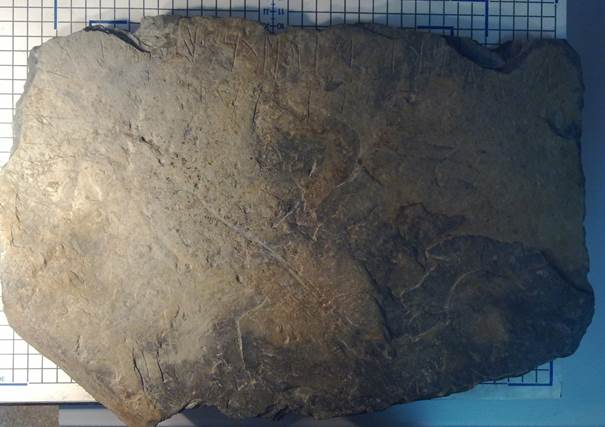
The Espanca ‘signary’ (photograph: author), Museu da Lucerna (2012)