
Dr. Azher Hameed Qamar
Postdoc Fellow COFUND Migration, Diaspora, Citizenship
ah.qamar@uni-muenster.de
Recently, as part of the COFUND (Migration, Diaspora and Citizenship) project at the University of Münster, I suggested the movie Green Border by Agnieszka Holland at Cineplex Münster. What began as a cinema screening gradually turned into a deeply emotional and thought-provoking experience, inviting reflection on migration, responsibility, humanity, and morality. Set in the forested border region between Belarus and Poland, the movie portrays the experiences of people caught in migration systems shaped by law, politics, and humanitarian crisis. In this blog post, I reflect on and share some thoughts about the movie’s portrayal of borders, migration, human lives, and dignity.
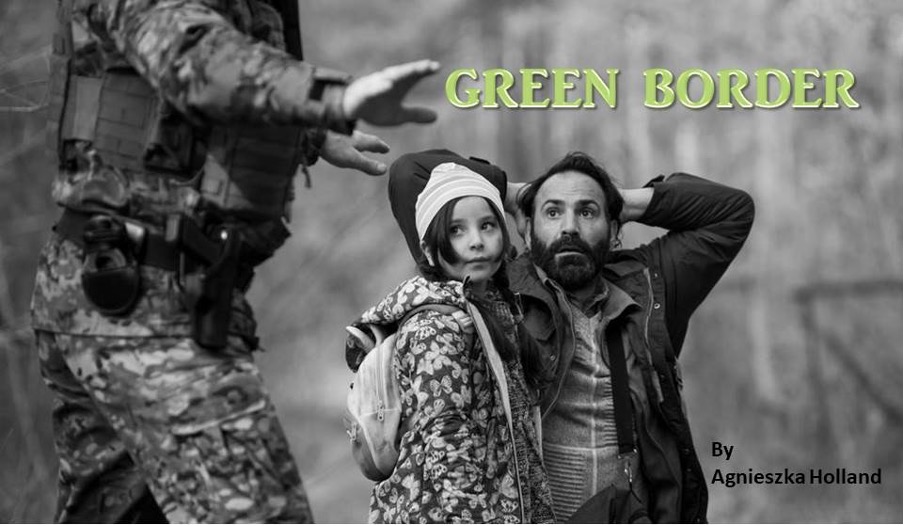
Still from Green Border (2023), directed by Agnieszka Holland. Presented at Cofund MDC Film Series, Cinema/Kurbelkiste Münster (University of Münster collaboration screening).
The movie Green Border engages us deeply with lived realities. It exposes enacted resilience that is a collective course of action to endure and survive while challenging a system marked by inhumanity. In an interview with Swedish Radio, Holland said “It’s a human story, and the most important thing is to give a voice and a face to those who were left without a voice and a face because of propaganda. To show that we are all human.”
The movie, on the one hand, connects us to the pain and suffering of migrants, and on the other hand demands a higher moral engagement – one rooted in empathy and a willingness to confront oppressive forces in the name of humanity and the sanctity of human life.
The movie begins with the hope of a Syrian migrant family seeking to enter Europe. The hopes, initially awakened by the Belarusian government’s promise of safe passage into Poland, are later shattered by both Belarusian and Polish border authorities. The movie portrays a raw, lived, survival-based resilience that emerges when systems fail to recognize humanity and human values.
Below is a breakdown of the movie’s key scenes that illustrate how resilience is practiced, shared, and at times painfully reclaimed.
The Swamp Crossing — Survival is a Collective Act
Several scenes in the movie depict the torture inflicted by the border police and the harsh weather conditions endured by migrants as they are repeatedly pushed back and forth between the Polish and Belarusian borders, abandoned in dark, wet, muddy, and freezing forests. Neither the brutality of the border forces nor the cruelty of the weather distinguish between children, elderly people, pregnant women, or breastfeeding mothers.
Throughout this struggle, the characters show endurance with a shared sense of resilience that appeared as a collective action to survive. With this sense of resilience, the strangers become connected through a mutual and communal determination. They care for children and pregnant women. They share their resources and stay together to fight for survival at any cost. Ultimately, the forest that is designed to strip people of their life and dignity becomes a site of enacted resilience – the resilience that does not let them give up. They move on with warmth, connection, and relationships that emerge from shared pain and suffering.
The Pushback Cycle — Human Resilience against an Inhuman System
While the migrants are repeatedly pushed back and forth by the Belarusian and Polish forces, they are treated as though they are disposable. Their money is taken, water is wasted in front of their parched lips, children and elderly people are assaulted, and they are mocked, called “stinky,” and stripped of dignity. The disrespect extends not only to the living but also to the dead bodies of those who died (or were killed) at the border.
The pushback cycle symbolically shows the systemic cruelty and dehumanization. The harsh loop of inhuman acts tends to destroy hope. However, the migrants do not give up on survival. They are tired and broken, yet they gather themselves each time they are pushed to face the hardships. In their silent cries of suffering and pain, we hear a powerful rebuttal to surrender their right to live.
The Activists’ Courage and Moral Resilience in the Face of Systemic Inhumanity
We see migrants trapped in the forest, suffering from hunger, injuries, and cold. At the same time we watch the heart touching moments when some Polish activists appear, showing courage and moral resilience to support them. They choose to uphold humanity with their skills and passion to serve the humanity. They frequently visit migrants to provide food, shoes, blankets, and medical aid. They encounter surveillance, legal threats, and the consequences of challenging the border police who want to stop them from helping.
The movie does not characterize these activists as heroes by romanticizing their actions. Instead, we see them arguing, burning out, becoming exhausted and frustrated. However, their physical and emotional exertion does not hinder their mission. They continue to return, driven by moral resilience and persistence in the name of humanity.
The movie also presents a Polish border guard who begins to question the brutality he witnessed and was expected to carry out himself. His internal struggle eventually leads him to a moral reckoning, and he refuses to allow institutional power to override his humanity and conscience.
Resilience: We Do Not possess it, We Enact It.
In the movie, enacted resilience appears in many different forms, inviting us to rethink the dominant understanding of resilience as merely heroic individual strength or the ability of a person to withstand crisis alone. We see in the movie that:
- Migrants sharing whatever little they have despite the scarcity surrounding them.
- Some activists doing everything they can, despite the risks and consequences they may face, to create support networks for migrants.
- Migrants consistently resisting the system that is designed to dehumanize them.
- Migrants and activists show resilience in action, practicing it through their choices and relationships, without surrendering to the conditions imposed on them.
Hence, the resilience demonstrated in the movie, is not a ‘heroic’ strength, but it appears in practice through collective care, moral action, and persistence. It is relational and communal rather than purely individual.
The movie does not answer the questions, but it tells a story that does not have a conclusion. The characters are separated, displaced, and killed, while their suffering continues unresolved and unforgotten. Their resilience is not an outcome, but an on-going process that leads a persistent struggle to move forward and survive. The movie invites us to think beyond abstract debates on migration. It engages us with what it means to respond as humans to other humans in situations of vulnerability.